By: Pete Smith, Jessica Taylor, and William Harper
Overview
For this project, you’ll be extracting data from seventeenth-century county court records. In the seventeenth century, the county clerk copied land deeds and wills, took down verbal testimony or “depositions”–recorded formal arrangements like agreements with Indigenous Nations, chattel sales, or labor contracts–and chronicled the decisions and orders of the county court, juries, and coroners’ inquests after suspicious deaths. If they have survived accidental fires, floods, and the American Civil War, all of these interactions from seventeenth-century “court days” are inside of deed books, will books, and order books. They are organized in whatever way made sense to the county clerk, who often served as clerk for years, if not decades. (You’ll be able to tell by his handwriting!) A page from a court book might look like this:
Oftentimes, so that he could leaf through the volume quickly and find a case later, the clerk wrote a summary in the left-hand margin or in brackets.
Documentation of peoples’ attempts to escape or self-emancipate are (so far) most frequently found in order books. In these, court members often handed down a punishment or restitution for time or goods lost onto someone who was caught as a “runaway.” The clerk noted individual parts of these cases in the order in which people through the door of the courthouse or provided documentation to him. Because of this, information about a case and the court’s decision are intermingled with non-related cases over many pages (and months). It’s important to look around for testimony or other legal documentation that might accompany an order for punishment, even if it’s not on the very next page.
Although less often, people who escaped also appear in letters of attorney, inventories of a deceased person’s estate, and testimony in cases about, say, a labor dispute or a conspiracy. Even if you don’t get every word, it’s important to read through these for content.
Land patents and sales, cattle mark registration [i.e., “Rob: Thomas His Marke”], and wills are very unlikely to mention an escape or escaped person in these records.
Much of the data extraction will come from records that have already been abstracted into digital text files. These are helpful in understanding difficult-to-read content of a particular entry in the court book, but should not be relied on as a transcript OR to capture all of the content on a particular page. Remember that many twentieth-century transcriptionists were looking for the names of (almost always white) ancestors of genealogists and famous planters like George Washington and Robert E. Lee. They were less likely to record the names or presence of enslaved people, Native people, and non-elites, particularly in documents like inventories. Second, it is possible that they missed an entry or even an entire page.
Contemporary spellings and abbreviations are often different than what we might expect today1. For many people in the seventeenth century, there was no “correct” spelling, and clerks also make much use of abbreviations of names and common words like “that” and “which” to save space and time. It is also possible for these elements to vary throughout a single entry or page.
General steps for extracting data from a transcription:
You’ll note the page number at the top of this or the following page. (Sometimes two pages that faced each other, or two pages on either side of the same sheet of paper, have the same number.)
Always start at the top of the page. Many court books have pages missing in the middle of a volume, and the case or document at the top might not reflect what was on the previous court book page.
Mentally note the end of an entry. Often, it ends with either signatures or “marks” of people who sign with their initials, an “X”, or symbol. Clerks frequently signed with the date a testimony, patent, or other document is recorded in the court book. Do not assume that the entry is done because you have reached a space or the bottom of the page.
Look for the summary of the case on the left (if this particular clerk used this organizational system). If it is an order about a “runaway” or someone who “absented” themselves, read and record this.
Once you’ve found an entry to transcribe, make sure you note the date that the court met and the court members who were present at that time. You may have to go back a few pages to find this information, but it is usually written in larger script to denote a new court session. That information may be located in previous pages, or may not be available at all. Briefly scan the pages in between the list of court members and the entry for notes about court members who showed up late (actually pretty common), or who recused themselves from a case or left early.
If you find a case that mentions a person who has “absented themselves” to run away, copy what you see as closely as you can, including any summary in the margin, so that other people can find it more easily. (There is a possibility that “absenting” themselves may refer to escaping debt, skipping church, or avoiding jury duty; read carefully to make sure it’s the right kind of “absenting”!) Some abbreviations use a superscript, where some letters appear smaller and above the line of the rest of the words (like this: “Ltr of Atty,” which means “Letter of Attorney” but takes up less space and time). Ignore superscripts as you transcribe like this: “Ltr of Atty.”
If a word doesn’t make sense to you, sound it out. Often, the clerk’s consonants are the same as ours, but his use of vowels might be different (“steed” might mean “stead,” “hoogs” probably means “hogs”). Remember that his version of English is different from ours!
If you don’t know a word or phrase, give it your best effort and put it in brackets with a question mark at the end (like this: [Letter of attorney?]). Feel free to transcribe your best guess inside of the brackets as well (like this: [Let– of –ney?]. If you can’t see the words at all–which will certainly happen if the scan is too dim or a piece of the page is missing–write in brackets [illegible]. Remember: do NOT rely on the abstracts or earlier transcriptions as any more than a guide.
A note on dates: For seventeenth-century colonists, two calendars were in use at the same time leading to two New Year’s Days: one on January 1, one on March 25. People often will record dates in between those two days in terms of both years. (Example: 25th February 1676/77; 1st of January 1676/7.) Because we use January 1 as New Year’s Day, we are recording the date as the later year to avoid confusion. (Example: 25th February 1676/77 would be 25th February 1677, or 1677-02-25 in the dataset).
Other Types of Documents
Much like court testimony today, a “Deposition” is a statement provided to the court by a person (or a proxy witness) in which a person swears to tell the truth and provides their version of events relevant to a court dispute. Depositions related to a case might be recorded by the clerk all in a single set of pages, but oftentimes (perhaps because a witness couldn’t make it to court that day, for example), depositions related to a single case were taken over the course of months.
A “letter of attorney” gives a person permission to represent someone else in court–which is all an attorney needed to be at this time. The attorney could be someone’s wife, a friend, or a fellow planter. The attorney may need to be present in court because the person involved in a case is sick or busy, lives at a distance, or any number of other reasons (once, it was because the person’s horse ran away). Generally, letters of attorney refer to land transactions, often found nearby in the court book, or to recovering debts. Because an indentured servant was essentially in debt, paid off in labor rather than money, some letters of attorney authorized a person’s representative to pursue an indentured or enslaved person when they cannot do so themselves. Most of the language in these is the same, but occasionally they take the form of a detailed personal letter, transcribed by the clerk. These can give us informally provided detail we wouldn’t find anywhere else.
An “Inventory” is a list of goods, land, buildings, and chattel belonging to a deceased person’s estate. Respected men in the community catalog everything in a person’s home and on their land, provide a monetary value, and provide the document to the court. Although most estates did not require an inventory, the process helped “settle the estate,” divide property among heirs, pay a deceased person’s remaining debts, and ensure that any wishes the deceased person left in writing (in a “will”) or by mouth were carried out. Servants and enslaved people are often listed at the start or end of an inventory and are assigned values. If someone had run away and was currently at large, it may be noted here.
A “bond” is an agreement witnessed in court or by others and recorded in the court book. This word covers a wide variety of documents, including labor agreements, loans, trade, and more. If an indentured servant agreed to serve additional time after running away, it may be noted here.
Transcribing Handwriting: Understanding a document can often mean having to decipher individual words or letters. The sections below provide examples of styles of text, common abbreviations, and samples of the handwritten records, with transcription to practice with. Becoming familiar with the structure and style of the records is the first step in learning to read them.
Letters and Alphabet: Review the image below for examples of the different ways letters could be written in the court records. This style of script was known as “Secretary Hand.” The letters C, E, G, H, P, and R, especially, can look unfamiliar. 2

Notes:
- Lowercase and uppercase U and V are oftentimes indistinguishable. So are I and J.
- Lowercase “e” is backwards.
- Lowercase “c” looks like “r.”
- Lowercase “s” can look like an “f” if it falls in the middle of a word (i.e, “Middlefex” instead of “Middlesex.”)
Common Words or Phrases
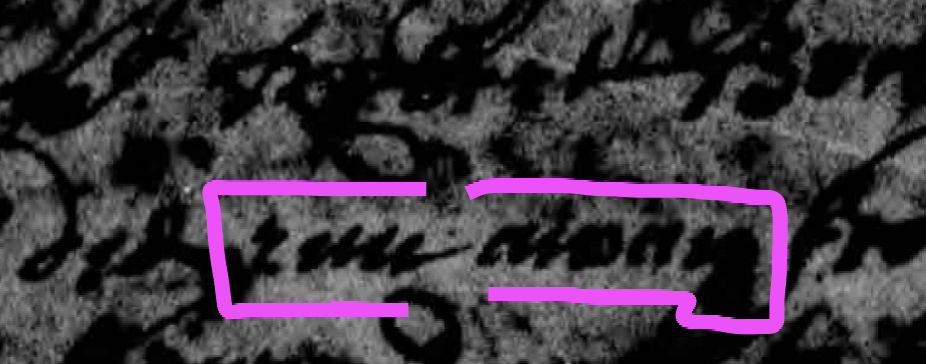
“Runaway”
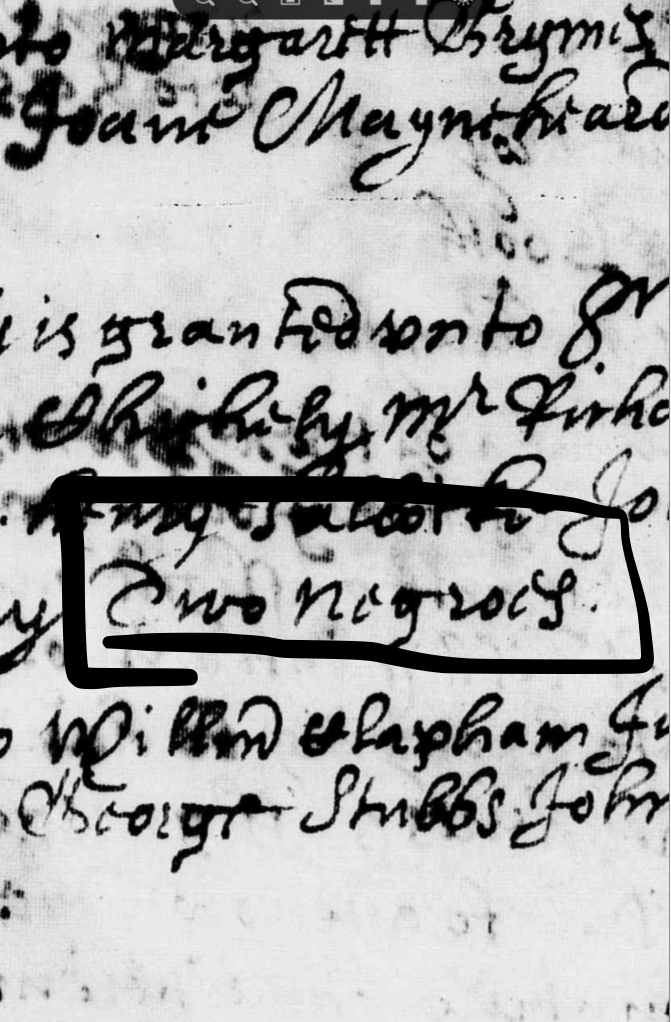
“Two Negroes”
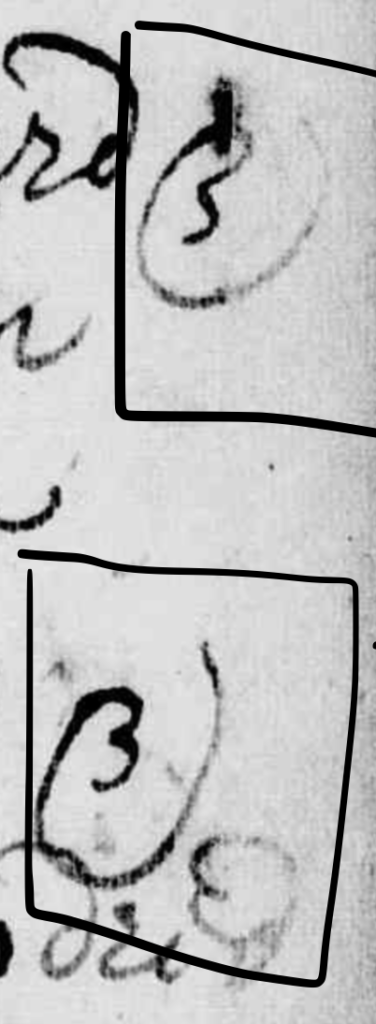
“&”
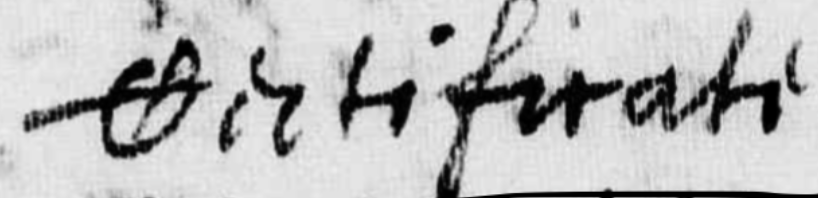
“Certificate”
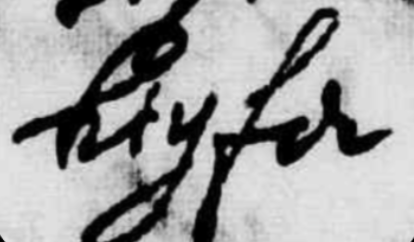
“Heifer (Female Cow)”
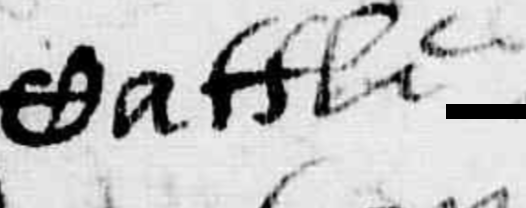
“Cattle”
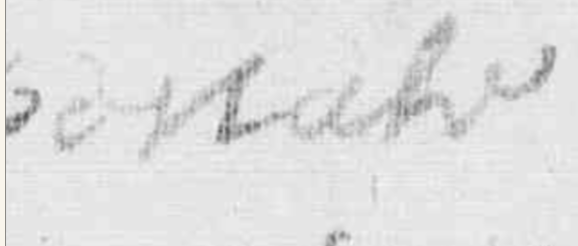
“Estate”
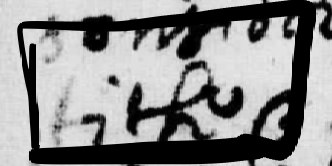
“Tithe”
Abbreviation Notes: Oftentimes, to write faster and take up less space, the clerk used symbols or abbreviations common in the seventeenth century. While not all-encompassing, here are some things to look out for:
- Superscript like this often means the word it is used in is abbreviated. Example: Atty means “Attorney”
- Colons often indicate a name or word is abbreviated. Example: Tho: means “Thomas”; Jno: means “John” or “Joan”
- Tildes can indicate a missing letter or set of letters in a word. Example: occasiõ means “occasion”; “informacõn” means “information.”
Example Transcription: This is a copy of an original manuscript of a court order. Below the included scanned picture is a text transcription.
The color code is as with the previous transcriptions:
- Yellow: people involved
- Green: main person/people involved
- Pink: indirect purpose (if the case refers to a previous case in a significant way)
- Gray: purpose of the current case/offenses committed
- Red: court order
- Blue: cost and/or punishment
Whereas Mary the wife of Roger Marbeck hath by [ ] complayned against her said husband for sundry great and insufferable abuses, and whereas the said Roger Marbeck being summoned as a [ ] and hath in contempt to the said summons absconded himself: it is ordered that the sheriff take the said Marbeck into his custody, wheresoever he shall find him, and him in safe custody to keep until he shall give good security to answer the said contempt at the next court to be held for the upper part of this county, and to answer the complaynt of his said wife, and to pay all cost ~alias Exec: (end transcription)
Download a sample set to practice transcribing and data entry here!
- “Paleography: Reading old handwriting 1500-1800, A Practical Online Tutorial” (The National Archives: https://www.nationalarchives.gov.uk/palaeography/where_to_start.htm)
↩︎ - Kent P. Bailey and Ransom B. True, A Guide to Seventeenth Century Virginia Court Handwriting, Research Bulletin 1 (Richmond, VA: Association for the Preservation of Virginia Antiquities,1980), 9.
↩︎
